
INSPIRATION
AND EXPLORATION

FALLING
Personally after viewing and analysing scene 12, I concluded that the concept of "falling" was the most important representation of this scene. In addition to the literal falling Nausicäa and her friend are doing in the scene, the concept of "falling" is further emphasised in a metaphorical reference to Nausicäa's distressed and catastrophic state.
Hence, after developing a focal point around "falling" I was inspired to portray my design around that concept.
The encounter of the Pythagorean switch maze, inspired the idea of a maze like structure for marbles to fall from. However I was having difficulty designing an appropriate maze like structure for this scene.
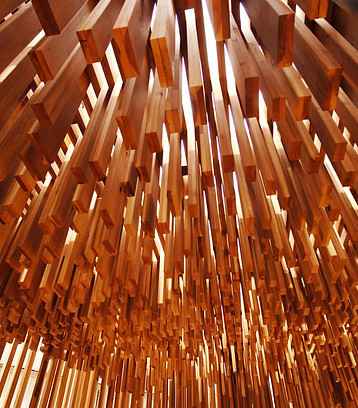
The introduction to David Adjaye's "Sclera" (left) in a Friday lecture aided in generating the first design of the model.
As seen on page 11 in my sketchbook, I designed a model considerate of the style in Adjaye's Sclera.
This model resembled Adjaye's work to some extent, however the roof of the model contained many holes from which we would be throwing sand from.
After lots of experimentation with the Adjaye inspired model, there were many faults and issues with its construction (shown on the development page). However after researching models and a maze like architecture style on a variety of networks, I encountered this building design on Pinterest, with both an anonymous name and designer.
This building design helped me completely change and transform the direction of my model, into a more reliable and stable skeletal structure for my work. The development was changing the structure to an extremely similar one to the model on the left. Additionally, instead of sand, each layer of the structure would contain a hole from which the marbles would fall from, resembling the Pythagorean switch maze.
However after a consultation with the metal and wood workshop, this design plan was quickly dismissed due to the lack of support the metal rods provided in my design. (Page 14-15 in sketchbook)

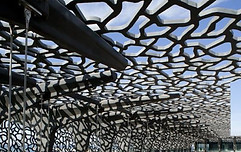
The previous failed attempts to design this model, aided and guided me to further explore potential ways to develop my design of the model. Therefore, through research on a variety of networks, I encountered the work of Livio Vaccini, an Italian architect that designed a maze like pattern I was aiming to recreate for my work.
After the consultations from the workshop and my attempts of model making from my previous ideas, I had developed a better comprehension of the quality I had to design for a successful model.
My previous attempt to make my design more abstract in order to resemble the organic shapes of nature evident in Scene 12, always resulted in a failed skeletal structure. Therefore from Vaccini's inspiration to generate more of a geometric maze like structure I created the finalised version of the model. (page 30-33 in sketchbook)
1st DESIGN
2nd DESIGN
3rd DESIGN
For this step of my development for Unit 2, I began to research and create mock models to generate the best possible result for my final design. The following photographs are some of the inspiration that encouraged the construction of the three models. They are classified by order of encounter and by which model they are from.
1st DESIGN


I was initially inspired to create a very simple cardboard structure for the first design. More specifically, I took a piece of cardboard and divided it in three. Then I inserted layers forming a maze like structure inspired by Adjaye's wooden work (seen above).
2nd DESIGN


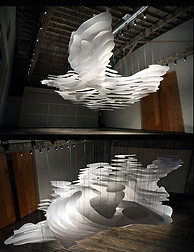
For the designing and construction process of the second model, I attempted to concentrate on the maze aspect I had explored at the start. I started researching maze like models (as seen above), however when I encountered the photo on the left I became very inspired to create a similar model for my work. The reason it inspired me was its composition of organic shapes, that resembled the shapes in the scene.
However making mazes requires a lot of precision and testing, so I decided to make the model in the workshop first.

I was very interested in demonstrating the narrative of the tension that the characters were experiencing from the start to the end of the scene through sound. Therefore I decided have different materials on each level of the construction to achieve softer of louder noises that correlate to the tension of the characters.
Alex and I cut up pieces of foam like material in squares and drilled a hole to cut out the empty section for the marble to fall from.
The square was cut using a scalpel and a ruler to measure the appropriate dimensions.


This is the final result of the 2nd Design. The images below demonstrate the thinking and experimentation process that resulted to the image on the left.


Towards the end of the construction, I decided to utilise a sponge, wood, foam, as well as acrylic to achieve different sounds when the marble interacts with it.
We were going to start as loud as possible to symbolise the high tension of the characters. Hence the first and loudest material being acrylic it was first, followed by wood, foam, then the sponge.
I noticed that the square shape of the layers makes the marbles roll off very rapidly, hence it will be difficult to film.
Therefore, I decided for the final piece to make the layers narrower to allow the marble to travel on it for longer.
2nd DESIGN
2nd DESIGN
NAUSICÄA:
THE VALLEY OF THE WIND
INSPIRATION
AND EXPLORATION
FALLING
Personally after viewing and analysing scene 12, I concluded that the concept of "falling" was the most important representation of this scene. In addition to the literal falling Nausicäa and her friend are doing in the scene, the concept of "falling" is further emphasised in a metaphorical reference to Nausicäa's distressed and catastrophic state.
Hence, after developing a focal point around "falling" I was inspired to portray my design around that concept.
The encounter of the Pythagorean switch maze, inspired the idea of a maze like structure for marbles to fall from. However I was having difficulty designing an appropriate maze like structure for this scene.
The introduction to David Adjaye's "Sclera" (left) in a Friday lecture aided in generating the first design of the model.
As seen on page 11 in my sketchbook, I designed a model considerate of the style in Adjaye's Sclera.
This model resembled Adjaye's work to some extent, however the roof of the model contained many holes from which we would be throwing sand from.
After lots of experimentation with the Adjaye inspired model, there were many faults and issues with its construction (shown on the development page). However after researching models and a maze like architecture style on a variety of networks, I encountered this building design on Pinterest, with both an anonymous name and designer.
This building design helped me completely change and transform the direction of my model, into a more reliable and stable skeletal structure for my work. The development was changing the structure to an extremely similar one to the model on the left. Additionally, instead of sand, each layer of the structure would contain a hole from which the marbles would fall from, resembling the Pythagorean switch maze.
However after a consultation with the metal and wood workshop, this design plan was quickly dismissed due to the lack of support the metal rods provided in my design. (Page 14-15 in sketchbook)
The previous failed attempts to design this model, aided and guided me to further explore potential ways to develop my design of the model. Therefore, through research on a variety of networks, I encountered the work of Livio Vaccini, an Italian architect that designed a maze like pattern I was aiming to recreate for my work.
After the consultations from the workshop and my attempts of model making from my previous ideas, I had developed a better comprehension of the quality I had to design for a successful model.
My previous attempt to make my design more abstract in order to resemble the organic shapes of nature evident in Scene 12, always resulted in a failed skeletal structure. Therefore from Vaccini's inspiration to generate more of a geometric maze like structure I created the finalised version of the model. (page 30-33 in sketchbook)
1st DESIGN
2nd DESIGN
3rd DESIGN
For this step of my development for Unit 2, I began to research and create mock models to generate the best possible result for my final design. The following photographs are some of the inspiration that encouraged the construction of the three models. They are classified by order of encounter and by which model they are from.
1st DESIGN
I was initially inspired to create a very simple cardboard structure for the first design. More specifically, I took a piece of cardboard and divided it in three. Then I inserted layers forming a maze like structure inspired by Adjaye's wooden work (seen above).
2nd DESIGN

For the designing and construction process of the second model, I attempted to concentrate on the maze aspect I had explored at the start. I started researching maze like models (as seen above), however when I encountered the photo on the left I became very inspired to create a similar model for my work. The reason it inspired me was its composition of organic shapes, that resembled the shapes in the scene. However making mazes requires a lot of precision and testing, so I decided to make the model in the workshop first.
I was very interested in demonstrating the narrative of the tension that the characters were experiencing from the start to the end of the scene through sound. Therefore I decided have different materials on each level of the construction to achieve softer of louder noises that correlate to the tension of the characters.
Alex and I cut up pieces of foam like material in squares and drilled a hole to cut out the empty section for the marble to fall from.
The square was cut using a scalpel and a ruler to measure the appropriate dimensions.

This is the final result of the 2nd Design. The images below demonstrate the thinking and experimentation process that resulted to the image on the left.


We were going to start as loud as possible to symbolise the high tension of the characters. Hence the first and loudest material being acrylic it was first, followed by wood, foam, then the sponge.
I noticed that the square shape of the layers makes the marbles roll off very rapidly, hence it will be difficult to film.
Therefore, I decided for the final piece to make the layers narrower to allow the marble to travel on it for longer.
Furthermore, I decided to add a sand base onto which the marbles can land on instead of plain wood. The sand landing will reflect the collapse Nausicäa and her friend have in Scene 12.
2nd DESIGN
2nd DESIGN
1st DESIGN
1st DESIGN
1st DESIGN
3rd DESIGN


3rd DESIGN
3rd DESIGN


As the project revolves around the thematic concept of the environment and conservation, we tried to use recycled materials to construct our model. Therefore we went to the scrap pile of the workshop and were lucky enough to find appropriate pieces.
Towards the end of the construction, I decided to utilise a sponge, wood, foam, as well as acrylic to achieve different sounds when the marble interacts with it.
The work of Livio Vacchini had the largest contribution in inspiring my design of the final model. The maze like structure of his work inspired me to generate a stable and functional model for the scene.


The construction process started out after I developed a scale plan drawing of the model which we used as guidance. I first cut out the legs of the model, which are responsible for the stability (left). Secondly I cut out the base, which was a thicker piece of wood in order to provide as much strength as possible for the model.
Finally the bases on which the layers of material are placed on were measured and cut out.
The cutting process involved drawing out the desired shape onto the wood, followed by utilising a specific cutting machine based on the shape drawn. Finally after the materials were cut, they were sanded down for a softer and more accurate finish.
The most challenging part of the cutting process was cutting the holes for the layers on the legs of the model. It required extreme precision, as small mistakes could result to the layer being loose.


After all the pieces were cut down and sanded, a strong PVA glue that dried transparent was utilised to unify the layers, the legs and the base. We had to press and hold down the model for a few minutes in order for the glue to dry properly.


After the skeletal structure of the model was completed, we focused on constructing the individual layers of the model as they are all unique to the other. I first drew a straight line to mark the placement of the wooden base for the layer (seen in middle picture), which was stuck on with PVA glue. Followed by placing the material of my choice on each level of the building. The end result can be seen on the right image.


The final steps for completing the model were decoration. I decided to pain the borders of the model white to demonstrate that the model is the reflection of Nauiscäa's airplane. Furthermore I attempted to utilise small pieces of wood for decoration around the individual material layers, however was unsuccessful as the wood was not sticking and looked messy.

FINAL PRODUCT
In conclusion I was very pleased with the outcome of the model. The model ended up having eight different layers made up of : metal, acrylic, polypropylene as well as plastic.
Evidently there is sand at the bottom layer symbolising the sand Nausicäa and her friend land on.
The overall experience the model generates, is told through the sound the marbles make with the layer they are encountering.
For instance, a textured metal is the first layer which results to the most noise and therefore reflecting the distraught state Nausicäa is in. Gradually the materials get softer until the marbles land in the sand where there is no noise just quiet.

FALLING


The model in general attains a very geometric and harsh shape, however the abstract and organic shape of the marbles tone down the harshness and simultaneously stand out in the model.